
V&A · London · Independent guide
V&A audio guide,
five stops, free.
Five recordings that start when you press play, no app and no ticket, because the museum is free too. The V&A's own database counts about 58,000 objects on display at South Kensington; photograph any of the others and Chiaro narrates that one.
Made by Chiaro. Not affiliated with the V&A.
The Raphael Cartoons
V&A, London
The five stops · 11 minutes of audio
Five stops, one walk,
in the order you will walk them.
Five objects, three levels, one building that everyone gets lost in. The route opens on Level 0 in the Raphael Court, Room 48a, a few minutes from the Grand Entrance, moves along the Cromwell Road front to the Ardabil Carpet in Room 42, then through to Canova's Theseus in the sculpture galleries, Room 22. Back at the Grand Entrance, steps lead down to Level -1 and Bernini's Neptune and Triton in Room 7; stairs climb to Level 1 and the Great Bed of Ware in Room 57. Budget roughly eleven minutes for the audio and half an hour on your feet, stairs included.
We tested each fact below against the V&A's own collection records and an independent second source; the galleries named here were verified as of 18 September 2026. The V&A closes galleries in rotation, and the South Asia Gallery with Tippoo's Tiger is shut until 2028, so should a label or a barrier contradict this page, go by the label and drop us a line.

Stop 1 of 5 · Raphael, Room 48a, The Raphael Cartoons (the Raphael Court), Level 0. Royal Collection, lent by His Majesty The King (ROYAL LOANS.2 to 8)
The Raphael Cartoons
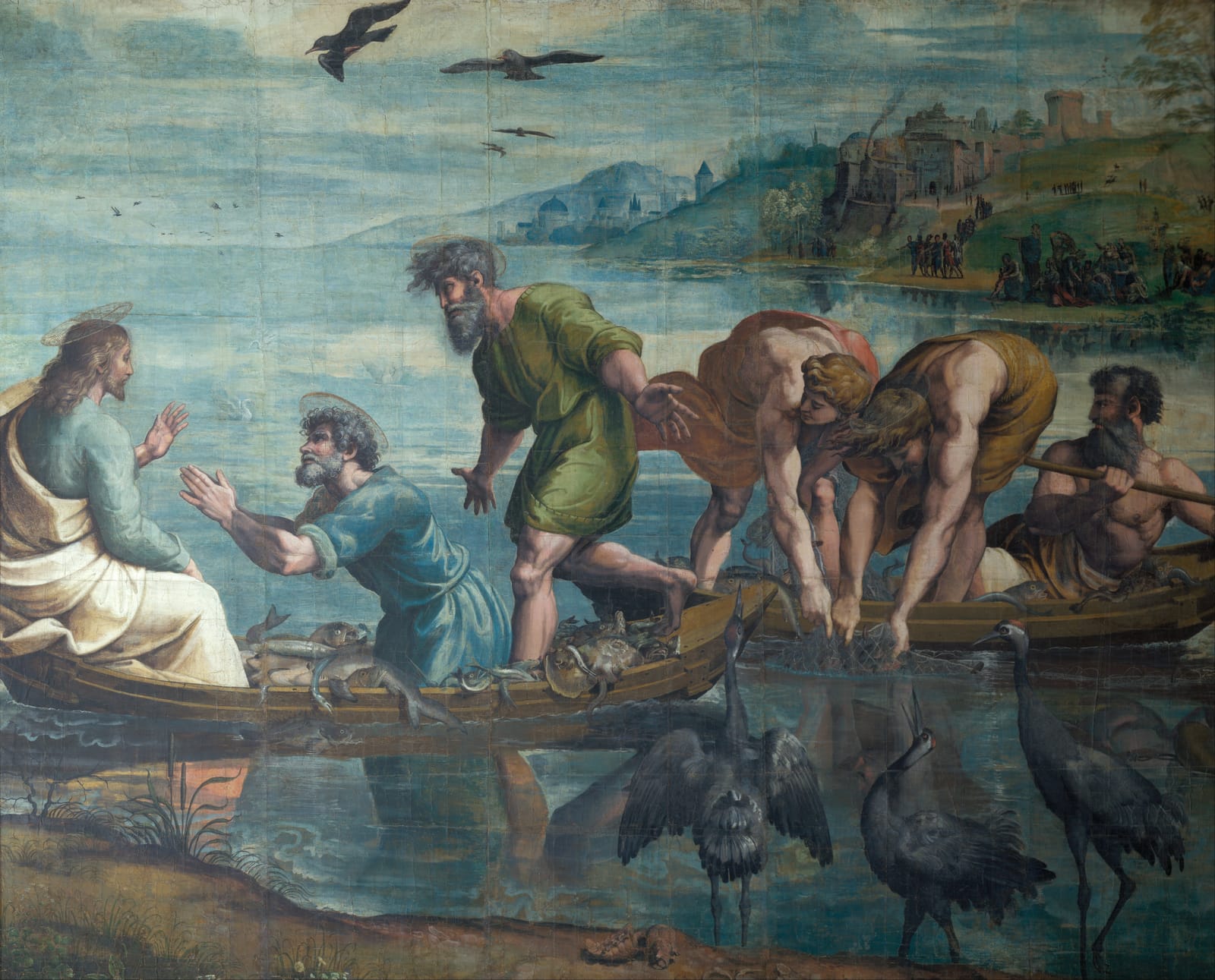
Raphael · About 1515–1516 · Bodycolour on paper, mounted on canvas; seven cartoons, each just over 3 m tall. The Miraculous Draught of Fishes, pictured, is 322 × 401 cm
Look for
- The vertical seams in every picture. The cartoons were cut into strips a yard wide for the weavers and only rejoined in the 1690s.
- The Mortlake weaving hung opposite The Miraculous Draught of Fishes. It is the mirror image of the cartoon, because the looms reversed the design.
- Peter in a blue tunic kneeling in the boat, and Christ's raised hand of blessing, in The Miraculous Draught of Fishes.
- The man in the red cap at the far left of Paul Preaching at Athens: Pope Leo the Tenth, who paid for all this.
Transcript (2:16)
The room is the first clue. It is almost exactly the size of the Sistine Chapel, 546 square metres against 548, and although the room was built for other collections and the cartoons only moved in from Gallery 94 in 1950, the match fits: these seven paintings were made for the Sistine Chapel, or rather to be turned into the tapestries that hung there.
Pope Leo the Tenth commissioned them from Raphael soon after his election in 1513. Michelangelo had finished the ceiling the year before, and the only wall space left was the lowest register, so Leo ordered a set of tapestries on the lives of Saint Peter and Saint Paul, and Raphael painted the full-scale designs. Each one is over three metres tall, painted in glue-based distemper on sheets of paper glued together. Raphael was paid a thousand ducats. The weaving in Brussels cost fifteen thousand.
Now look for the vertical seams running down every picture. Before they went to the weavers, the cartoons were sliced into strips about a yard wide, so that each strip could sit beside a loom. Because the Brussels looms worked from behind, everything here came out reversed in wool and silk. The proof is in the room: a seventeenth-century Mortlake weaving of The Miraculous Draught of Fishes hangs facing its own cartoon, in mirror image.
Ten cartoons went to Brussels. Seven came back into history. After the tapestries were delivered, the designs vanished for almost a hundred years, then turned up in Genoa, where in 1623 the young Prince Charles, the future Charles the First, bought them for three hundred pounds. He wanted working patterns for his new tapestry works at Mortlake, and the price says how they were valued: as shop drawings, not as Raphaels. When Charles was executed and his collection sold off, Oliver Cromwell kept these back. In the 1690s the strips were finally rejoined at Hampton Court, and Christopher Wren built them a gallery with green silk curtains against the light.
They still belong to the King. Queen Victoria lent them to this museum in 1865 in memory of Prince Albert, and in the Second World War they were bricked up in a shelter in the basement.
Find The Miraculous Draught of Fishes. Simon, soon to be renamed Peter, kneels in a blue tunic in the boat and Christ raises a hand to bless him, while the catch spills over the side. The tapestry woven from this hung in the Sistine Chapel on the twenty-sixth of December 1519, and Raphael was probably there to see it. Then find Paul Preaching at Athens and the man at the far left in a red cap, listening. That is Leo the Tenth, who paid for all of it, and put himself in the audience.
14GTR, CC0, via Wikimedia Commons. Photo: 14GTR

Stop 2 of 5 · Islamic Middle East, Room 42, The Jameel Gallery, Level 0
The Ardabil Carpet
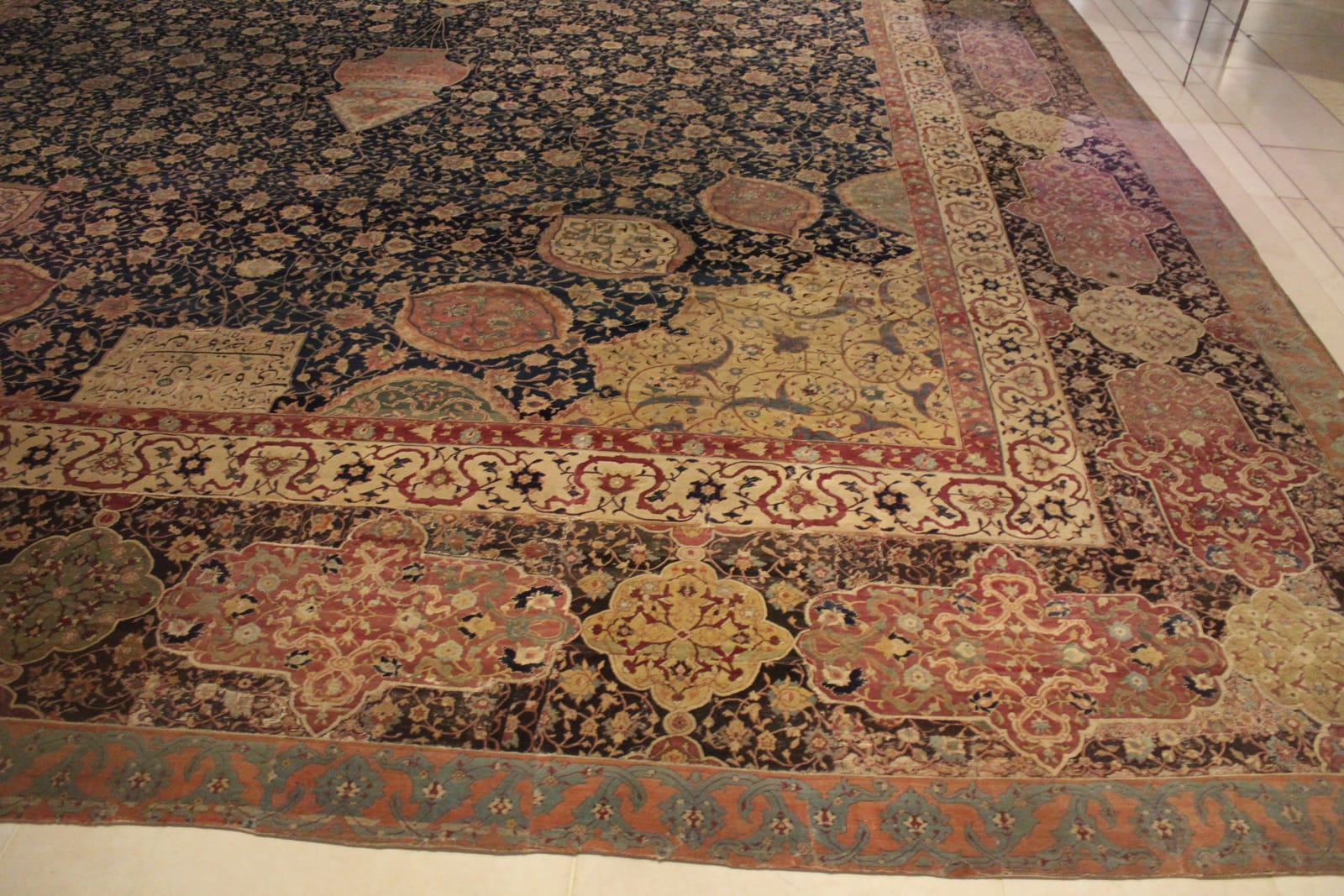
Unknown weavers, Safavid Iran; the inscription names Maqsud of Kashan · 1539–1540 · Wool knotted pile on a silk foundation, ten colours, 1044 × 535.5 cm
Look for
- The light. The case is lit for ten minutes on the hour and half hour, and dim in between, so time your visit.
- The two lamps hanging from the yellow central medallion, one visibly bigger than the other.
- The white panel at one end with the verses, the signature and the date 946.
- Faint shifts of shade in the blue ground where a new batch of dyed wool began.
Transcript (2:06)
If the room looks dim, wait. The case is lit for ten minutes on the hour and half hour, and kept low in between to save the colours. When the lights come up, look at the dark blue field and the yellow medallion in the centre.
By the museum's own reckoning this is the oldest dated carpet in the world, and one of the largest: just over ten metres by five. Find the small white panel knotted into the field at one end. It carries two lines by the fourteenth-century poet Hafiz, "Except for thy threshold, there is no refuge for me in all the world," then a signature, "the work of a servant of the court, Maqsud of Kashan," and a date, 946 in the Muslim calendar, which is 1539 to 1540. Maqsud was probably the court official in charge of the work.
The carpet was commissioned by Shah Tahmasp, ruler of Safavid Iran, as one of a pair for the shrine of his ancestor Shaykh Safi al-Din in the town of Ardabil, in the north-west of the country. The warp and weft are white silk; the pile is wool in ten colours, around 340 knots to the square inch, and up to ten weavers may have worked on it at once for several years. The dyes came from pomegranate rind and indigo, which is why the blue shows faint ripples where one batch of wool ended and the next began.
Now find the two lamps hanging from the central medallion. One is clearly larger than the other. One explanation is perspective: sit at the small-lamp end and they would look the same size. The museum notes there is no other evidence for that trick in 1530s Iran, and offers another reading: the flaw is deliberate, because perfection belongs to God alone.
British travellers saw the carpet still lying in the shrine in 1843. About 1888, after an earthquake damaged the buildings, it was sold, possibly to pay for repairs, to a Manchester trading firm, who patched it heavily. What you are looking at is one carpet restored with pieces cut from its twin. What was left of the twin was sold to an American tycoon in 1892, reportedly on condition that it never came back to Britain; it is in Los Angeles today.
William Morris got this one to London. As an adviser to the museum he inspected it and reported it "logically and consistently beautiful," and in March 1893 the museum bought it. For decades afterwards it hung on a wall like a picture. Only in 2006 did it come down onto the floor, into this case, the way a carpet is meant to be seen.
APK, CC BY 4.0, via Wikimedia Commons. Photo: APK

Stop 3 of 5 · Sculpture, Room 22, The Dorothy and Michael Hintze Galleries, Level 0
Theseus and the Minotaur
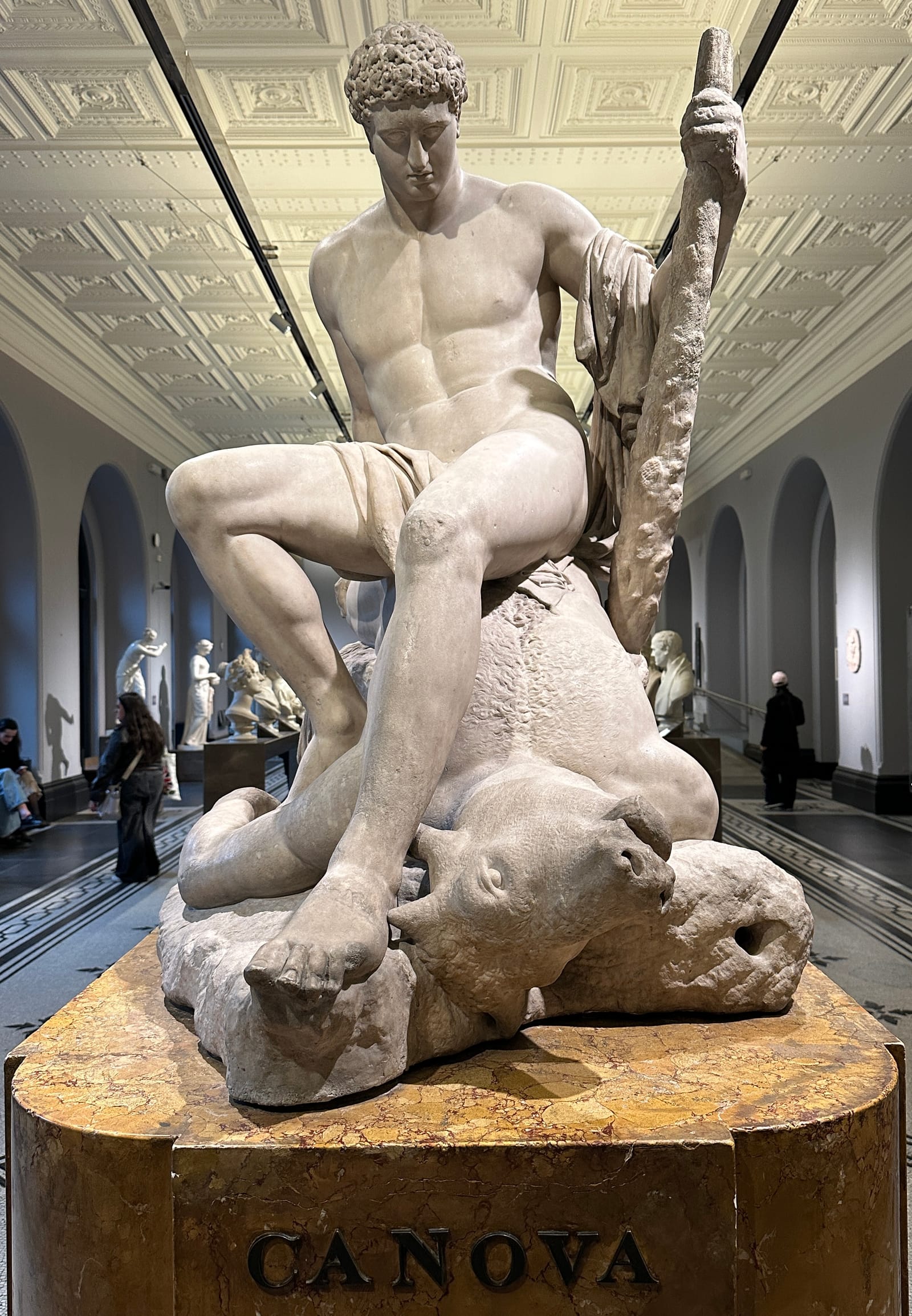
Antonio Canova · 1782 · Marble, 145.4 × 158.7 × 91.4 cm, about 940 kg
Look for
- The coils of thread on the rock by the Minotaur's left leg: Ariadne's thread, the way back out of the labyrinth.
- Theseus's face. He looks down at the dead creature with something closer to pity than triumph.
- The club in his left hand and his right hand resting on the Minotaur's leg.
- The Minotaur's body draped over the rock in a long reversed S.
Transcript (1:51)
Nothing is happening. That is the point. The fight is over, the monster is dead, and the hero is sitting on it the way a tired man sits on a wall. Look at his face: not triumph, something nearer to pity, as he looks down at the thing he has just killed.
Antonio Canova was in his twenties when he carved this, newly arrived in Rome from Venice in 1780. The block of marble was a present from his patron Girolamo Zulian, the Venetian ambassador, who let Canova pick the subject, and he chose Theseus and the Minotaur from Ovid. His friend Gavin Hamilton, a Scottish painter and dealer who knew what sold, gave him the advice that made the piece. Do not show the struggle, he said. Show the moment after. A still group would win more praise than a violent one.
He was right. When the finished marble appeared in 1782, people took it for an ancient Greek original and were startled to learn it was new. An engraving by Raffaello Morghen carried the composition across Europe, and Canova was on his way to being the most celebrated sculptor of his age.
Now look at the details Canova hid for you. Theseus holds a club in his left hand and rests his right on the Minotaur's leg. The creature, half man and half bull, lies over the rock in a long reversed S. And down by its left leg, look for coils of thread. That is the ball of thread Ariadne gave Theseus so that he could find his way back out of the labyrinth. The whole story is there, in a few loops of marble.
The group weighs 940 kilograms, and its travels are as good as the myth. By the time it was finished Zulian had been posted to Constantinople, and he let Canova keep it. Canova sold it to an Austrian count, who carried it to Vienna in 1788. In 1822 the Marquess of Londonderry bought it and installed it in Londonderry House in London. When that house was emptied for demolition in the 1960s, the museum bought the marble for three thousand pounds, a third of it from the National Art Collections Fund. It has been in the museum since 1962, resting on its monster, in no hurry at all.
APK, CC BY 4.0, via Wikimedia Commons. Photo: APK

Stop 4 of 5 · Europe 1600-1815, Room 7, The Sheikha Amna Bint Mohammed Al Thani Gallery, Level -1
Neptune and Triton
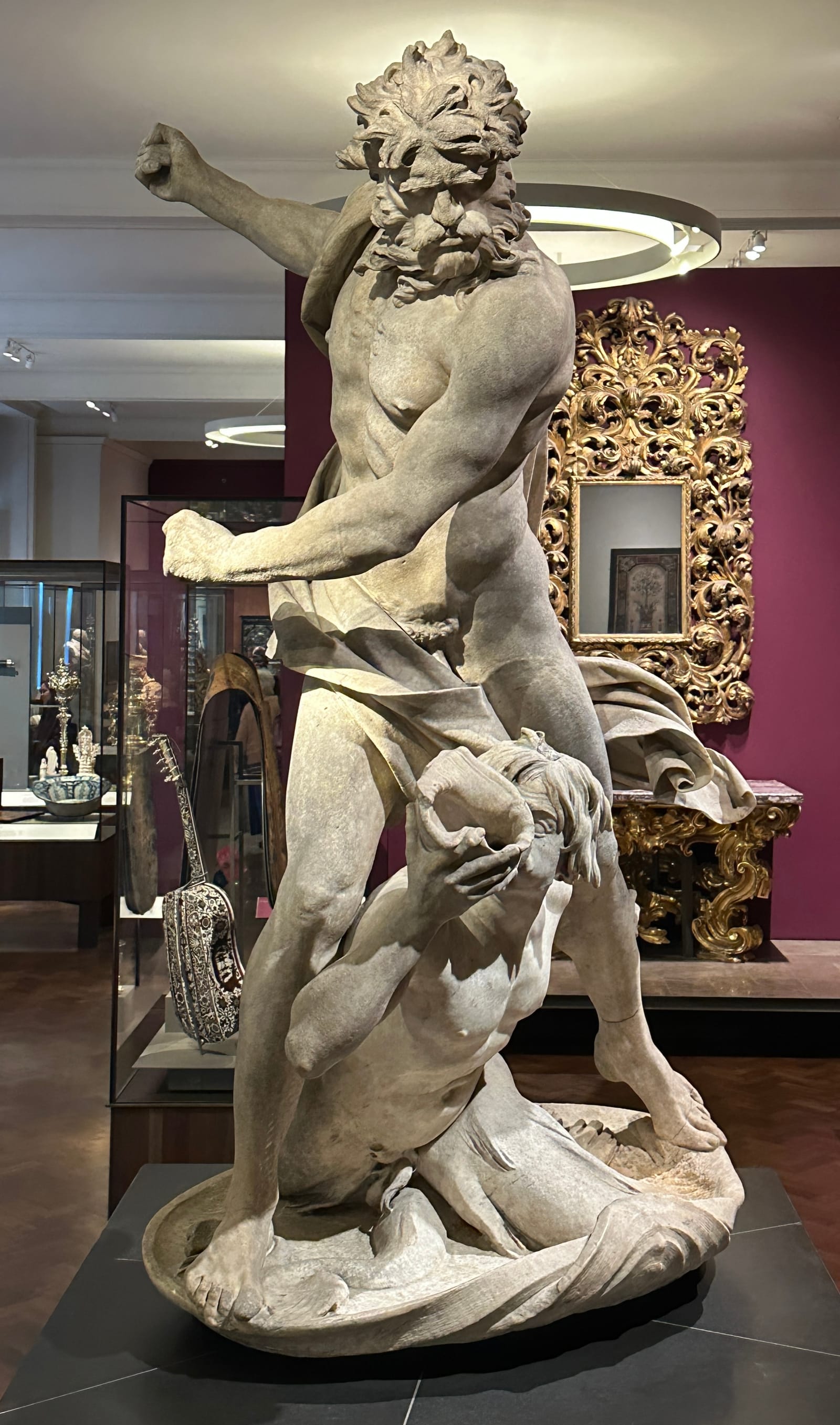
Gian Lorenzo Bernini · 1622–1623 · Marble, with a wooden replacement trident, 182.2 cm high, about 842 kg
Look for
- The conch shell at Triton's mouth. This was the fountain's spout, and a single jet of water came out of it.
- The trident. It is wood, a replacement for the lost original.
- The loose end of Neptune's cloak, carved to look like a dolphin's head.
- Triton's two tails, and his shoulder wedged between Neptune's thighs.
Transcript (2:10)
Stand back far enough to see the whole thing, then look at the boy's mouth. Triton is blowing a conch shell, and for more than a century and a half water shot out of it. This is a fountain. It stood at the head of a great fish pond in the garden of the Villa Montalto in Rome, the centrepiece of a whole system of cascades, and visitors in the seventeenth and eighteenth centuries listed it among the sights of the city.
Cardinal Alessandro Peretti Montalto commissioned it, and Gian Lorenzo Bernini carved it in just under a year, between March 1622 and February 1623, when he was not yet twenty-five. It comes right between two of his most famous groups, Pluto and Proserpina and Apollo and Daphne, both still in the Villa Borghese. The cardinal died in June 1623, a few months after it was finished.
Look at what the sea god is doing. Neptune stands on a shell, weight thrown forward onto his right leg, nude except for a cloak, and drives his trident down towards the water while Triton, wedged between his legs, sounds the alarm. Which story this is has been argued for centuries. It may be Ovid's Flood, where Neptune orders Triton to blow the conch and call the waters back. Or it may be Virgil, where Neptune raises the trident against a storm and starts a threat, "Quos ego", "Whom I…", and never finishes the sentence. Bernini's own biographer, Filippo Baldinucci, got the cast wrong and called the boy Glaucus, a fisherman who turned into a merman, so for generations prints called this Neptune and Glaucus.
Now the small things. The trident is wood, a replacement for the lost original. Look at the loose end of Neptune's cloak, carved to look like a dolphin's head. Look at Triton's tail: he has two. And look at the way the group spills outward in every direction. The art historian Rudolf Wittkower called this the first Bernini in which the silhouette is broken, the moment he found his full Baroque freedom.
Then follow it to London. In 1786 the group was sold out of the Montalto garden to the British dealer Thomas Jenkins, and then to the painter Sir Joshua Reynolds, who kept it for the rest of his life. After he died in 1792 it went to Lord Yarborough, who stood it in his garden in Chelsea, and later at his country house in Lincolnshire. The museum bought it from the family in 1950 for fifteen thousand pounds, with help from the National Art Collections Fund, and a fountain that once announced a cardinal's garden now stands dry in a basement in South Kensington.
Matt Brown, CC BY 2.0, via Wikimedia Commons. Photo: Matt Brown

Stop 5 of 5 · British Galleries, Room 57, Level 1
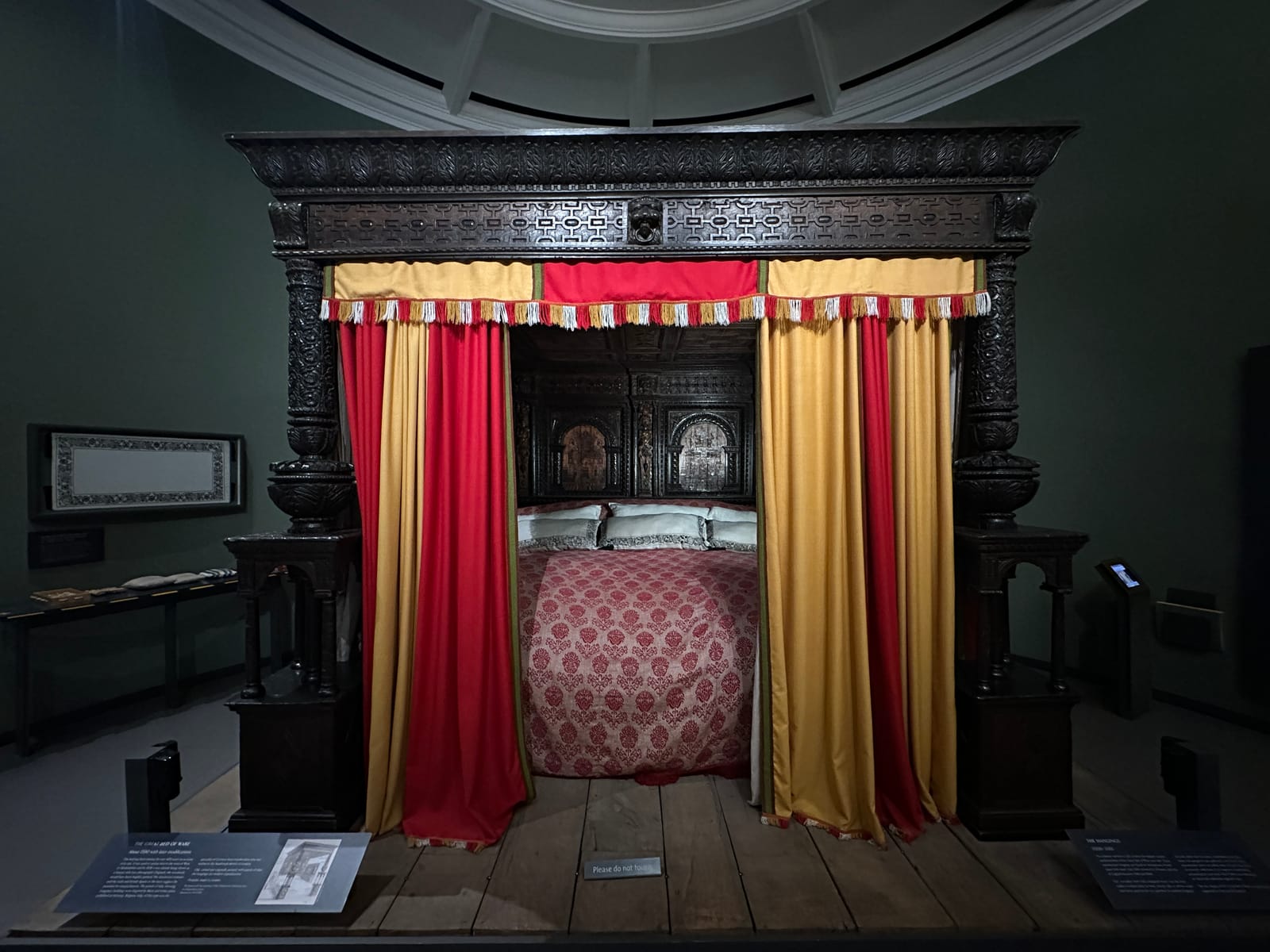
The Great Bed of Ware
Unknown English maker, probably Ware or London; marquetry in the school of Hans Vredeman de Vries · 1590–1600 · Oak, carved, inlaid with marquetry and painted, 267 × 326 × 338 cm
Look for
- Carved initials and red wax seals on the bedposts and headboard, left by guests over four centuries.
- The three carved figures dividing the headboard, two men and a woman, with a satyr at each side. Traces of their original paint remain.
- The two arched marquetry panels inlaid in the headboard, designed in the manner of Hans Vredeman de Vries.
- The posts, cut down at some point and missing their capitals, which is why the bed is a little shorter than it was built.
Transcript (2:37)
It is 326 centimetres wide and 338 deep, and the museum knows of no other Elizabethan bed anywhere near this size. Before you read a word of the label, walk up to the posts and look for initials cut into the oak, and for small blobs of red wax pressed onto the wood. Those are guests. For more than three hundred years people who slept here carved their names into the bed and sealed their visit with wax, and the marks are still there.
Because this was never a bed for a palace. It was almost certainly built as a stunt, to pull travellers into an inn at Ware in Hertfordshire, twenty-two miles north of London, a day's ride away and a staging post on the road north. The town was full of inns competing for the trade, and one of them had the biggest bed in England.
It worked. The earliest mention comes from a German prince who passed through in 1596 and wrote in his diary of a bed at Ware in which four couples might comfortably lie side by side. Five years later Shakespeare put it into Twelfth Night, where Sir Toby Belch describes a sheet of paper as big enough for the bed of Ware, and he did not need to explain the joke, because his audience already knew. Ben Jonson called it the great bed at Ware in 1609, and the name stuck. The stories grew with the fame. A writer in 1732 claimed it held twenty couples. Somebody painted the date 1463 on the headboard, now faded, to back up a tale that it was made for King Edward the Fourth, and the museum says the carpenter Jonas Fosbrooke, still named as its maker in many books, was invented for a London pantomime in 1839.
Look at the headboard. Two arched marquetry panels, inlaid in the manner of the Dutch designer Hans Vredeman de Vries, divided by three carved figures, two men and a woman, with a satyr at each side. They were once brightly painted, and traces of the paint survive. The bed is a little shorter than it was built: the posts have been cut down and lost their capitals, and the frieze along the top is a replacement. The hangings are modern recreations of period fabrics. Originally, curtains would have closed it on three sides for warmth and privacy, and the museum's own notes record that the bed cords holding up the mattresses were kept taut with special tighteners, which it says is where the phrase sleep tight comes from.
The bed left the inns in 1870 for the Rye House Hotel in nearby Hoddesdon, a pleasure garden with a fairground, where it stood in its own building with a set of antlers on top and the landlord would swear visitors over it for a fee. This museum was offered it in 1865 and refused, calling it a coarse and mutilated relic. In 1931 it changed its mind and paid four thousand pounds, half of it from the National Art Collections Fund, mostly to stop the bed going abroad.
In 2012 it went home for a year. Ware Museum built a room for it, and more than thirty-four thousand people came to see a bed. Then it came back here, to Room 57, carrying four centuries of other people's initials.
Independent guide · Chiaro
Point Chiaro at anything in the V&A.
The page has room for five objects; the building has about fifty-eight thousand on show and seven miles of galleries. Hold your phone up to the plaster cast of Trajan's Column, a Japanese lacquer chest, a Rodin bronze whose label runs to two lines: Chiaro explains the object and how it reached South Kensington, and goes on answering questions for as long as you stay.
Before you go
Getting there
Cromwell Road, London SW7 2RL. The Cromwell Road entrance is the main one, with the information desk, cloakroom and shop, and it is step-free. The Exhibition Road entrance is also step-free. The Tunnel entrance, at the end of the subway from South Kensington station, has steps.
South Kensington station, on the Circle, District and Piccadilly lines, is a five-minute walk at street level or about four minutes through the subway tunnel, which has steps. Gloucester Road is ten minutes. The nearest step-free station is Knightsbridge, fourteen minutes. The V&A warns that Piccadilly line upgrade works through 2026 and 2027 may disrupt journeys.
Tickets
- Admission costs nothing and needs no reservation. Only the temporary exhibitions charge, and for those the museum recommends booking online in advance.
- Hours run 10.00 to 17.45 daily, stretching to 22.00 on Fridays, when some galleries still shut at the usual time. The museum closes on just three days a year: 24, 25 and 26 December. Staff start clearing the galleries thirty minutes before closing. Wheeled luggage and bags bigger than 56 × 45 × 21 cm go to the cloakroom, which charges per item.
- The Ardabil Carpet is lit for ten minutes on the hour and half hour. Arrive in Room 42 a couple of minutes early.
- Galleries close in rotation. The South Asia Gallery, home of Tippoo's Tiger, is shut until Spring 2028 and the Fashion Gallery until Autumn 2028; check the gallery-closures section of the visit page before you go.
The official audio guide
The V&A's visit, FAQ and access pages list no audio-guide handset for hire and no paid app for the permanent collection. What they list is free: self-guided trails on vam.ac.uk, a web audio guide for the Europe 1600 to 1815 galleries, and audio descriptions of each Raphael Cartoon by QR code in the Raphael Court. The five stops here cost nothing either; anything beyond them, the Chiaro app can pick up.
Official site →Questions
Is there a free V&A audio guide?
Yes, this one: five objects, each with a recording and a transcript, which play right here on the page without installing anything. The V&A itself publishes free trails and a web audio guide for its Europe 1600 to 1815 galleries. Photograph anything else in the building and the Chiaro app will describe it aloud.
How much is the official V&A audio guide?
The museum's own pages list no paid one. The V&A offers no audio-guide handset for hire and no charged guide app for the permanent collection; its own audio, the Europe 1600 to 1815 web guide and the Raphael Court descriptions, is free, and so are its trails.
Where is the Great Bed of Ware in the V&A?
Room 57 of the British Galleries, on Level 1, one floor up from the Grand Entrance on Cromwell Road. The V&A's own Shakespeare trail through the British Galleries stops there too.
Where are the Raphael Cartoons?
Room 48a, the Raphael Court, on Level 0, a few minutes from the Grand Entrance. The seven cartoons belong to the Royal Collection and have been lent to the V&A since 1865; a Mortlake weaving made from one of them hangs opposite.
Is the V&A open on Mondays?
Yes, and every other day too; there is no weekly closing day. Doors are 10.00 to 17.45, and on Fridays the museum stays open until 22.00. The only closed days are 24, 25 and 26 December.
How long does the V&A take?
Our five stops take around eleven minutes to hear and half an hour to walk, counting the stairs. The museum has 145 galleries on five floors and about 58,000 objects on display, so a full visit is a day and still a selection. Entry is free, so many Londoners do it in slices.
More audio guides
Made by Chiaro. Not affiliated with the V&A.