
Musée de l'Armée · Paris · Independent guide
Musée de l'Armée audio guide,
five stops, free.
Five recordings for Les Invalides that start from this page, nothing to install. Everything else in a collection of close to 500,000 objects, from a courtyard cannon to a marshal's baton, Chiaro takes from a photo.
Made by Chiaro. Not affiliated with the Musée de l'Armée.
Armour of the Dauphin
Musée de l'Armée, Paris
That was the free part
Chiaro narrates any work in the Musée de l'Armée from a photo.
The five stops · 11 minutes of audio
Five stops, one walk,
in the order you will walk them.
The route crosses the museum's three departments and ends under the Dôme. Begin in the arms and armour galleries with the black-and-silver armour made for the Dauphin who became Henri II, climb to the Two World Wars rooms in the west wing for Vallotton's Verdun, go round by the galleries to the Louis XIV to Napoleon department for Ingres's Napoleon on his throne and Vizir, the Emperor's stuffed Arabian stallion, then walk out to the Dôme des Invalides and down the stairs to the red sarcophagus. The commentary runs to about ten and a half minutes; with the stairs, count on roughly an hour and a quarter on your feet.
Three sources stand behind each fact here: musee-armee.fr, the museum's own database of its holdings, and one outside reference; the departments named on this page were confirmed on 18 September 2026. The museum gives no room numbers for these works, and the armour department's Royal Room is shut for renovation at the time of writing; wherever a label or a barrier on the day tells a different story, it wins, and a line from you helps us fix the page.
MarieAmu, CC0, via Wikimedia Commons. Photo: MarieAmu

Stop 1 of 5 · Arms and armour department, 13th – 17th century
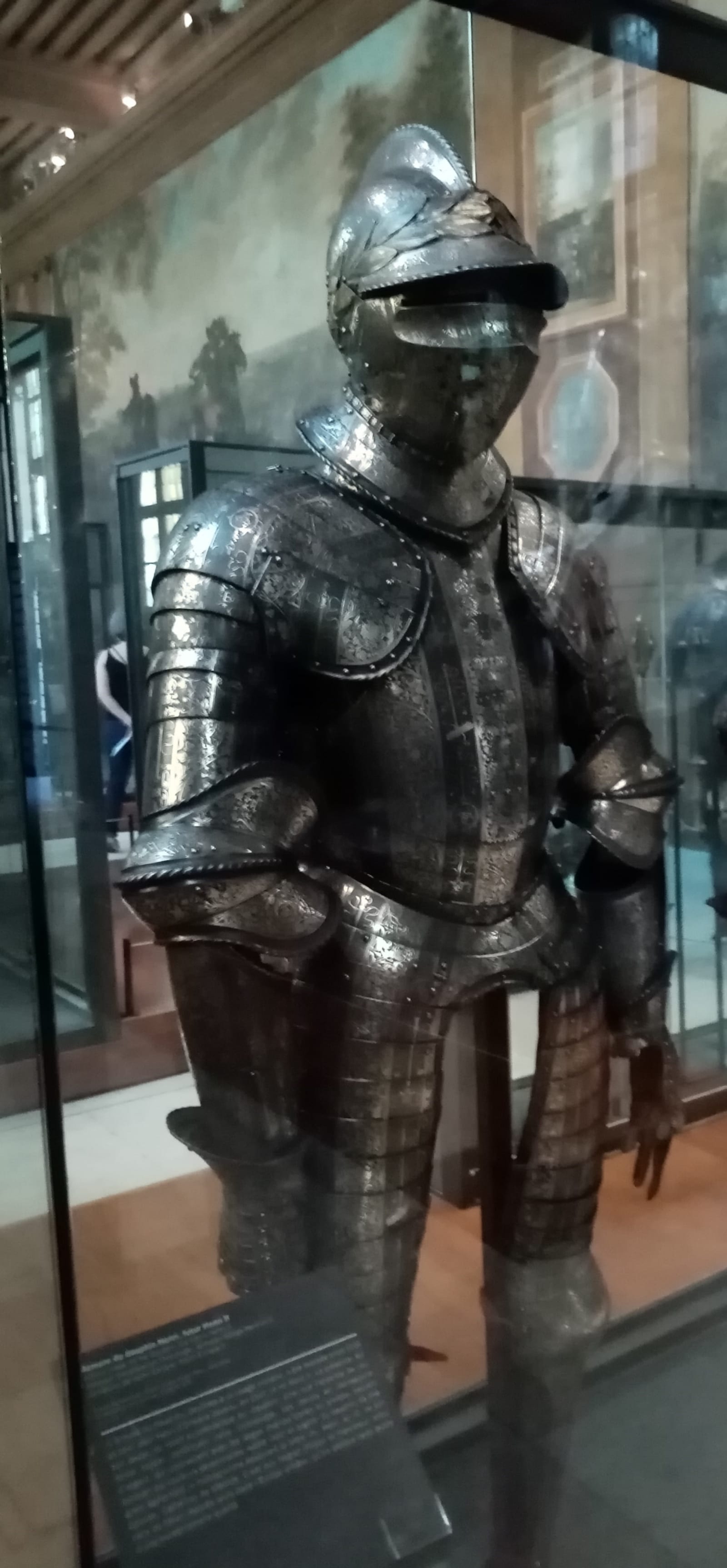
Armour of the Dauphin
Filippo and Francesco Negroli, Milan · c. 1540 · Blackened iron damascened with silver and gold, 175 cm, 19.7 kg
Look for
- The monogram: an H for Henri interlaced with a C for Catherine de' Medici, which also reads as a D for Diane de Poitiers, his favourite.
- Pairs of dolphins facing each other. Dauphin is French for dolphin, and it was the heir's title, so the fish are a pun on the wearer.
- No crown anywhere in the decoration. He was heir, not yet king, which is how the museum dates the suit to between 1536 and 1547.
- The weight on the label, 19.7 kilos. Parade armour is light; this was made to be fought in.
Transcript (2:13)
Stand close to the glass and let your eyes adjust. The metal is black, not polished silver, and the black is the point. It is iron that has been deliberately darkened, then inlaid with silver and gold in lines of scrolling foliage that run down every plate in parallel. Black and silver were the personal colours of the man it was made for, Henri d'Orléans, second son of King François the First.
He was not supposed to inherit anything. In 1536 his elder brother François died a few days after a game of tennis, with rumours of poisoning flying at once, and Henri, at seventeen, became the Dauphin, the heir to France. This armour was made for him in that in-between decade. Look for a crown anywhere in the decoration and you will not find one. That absence is how the museum dates it: after 1536, when he became heir, and before 1547, when he became king.
Now find the monogram. An H for Henri is interlaced with a C for his wife, Catherine de' Medici. Look again and the same shape reads as a D. D for Diane de Poitiers, the older woman the museum politely calls the prince's favourite. The bow and quiver worked into the decoration, the attributes of the huntress Diana, point the same way.
There are dolphins too, in facing pairs. The French word for dolphin is dauphin, and the heir's title came from the same word, so the fish are a pun on the wearer. Three interlaced crescent moons repeat across the plates, an emblem the Valois family favoured.
The whole suit stands 1.75 metres and weighs 19.7 kilos. That weight matters. Parade armour is thin and light because nobody strikes it. This is heavy enough to fight in, which is why the museum calls it war armour. It came from Milan, from the Negroli family of armourers. Filippo Negroli and Francesco Negroli, who specialised in exactly this silver inlay, called damascening, probably shared the work.
It sat in the French Crown's collections until 1797, passed through the national library in the Revolution, and reached the artillery museum, this museum's ancestor, in 1872.
Henri became king in 1547 and reigned twelve years. In the summer of 1559, at a tournament held to celebrate a peace treaty, a lance splinter from Gabriel de Montgomery, the captain of his own Scottish Guard, wounded him, and the great surgeon Ambroise Paré could not save him. He died ten days later. The suit in front of you was built for the battlefield. The wound that killed the man it was built for came from the tournament ground.

Stop 2 of 5 · Two World Wars department, 20th century, west wing of the main courtyard
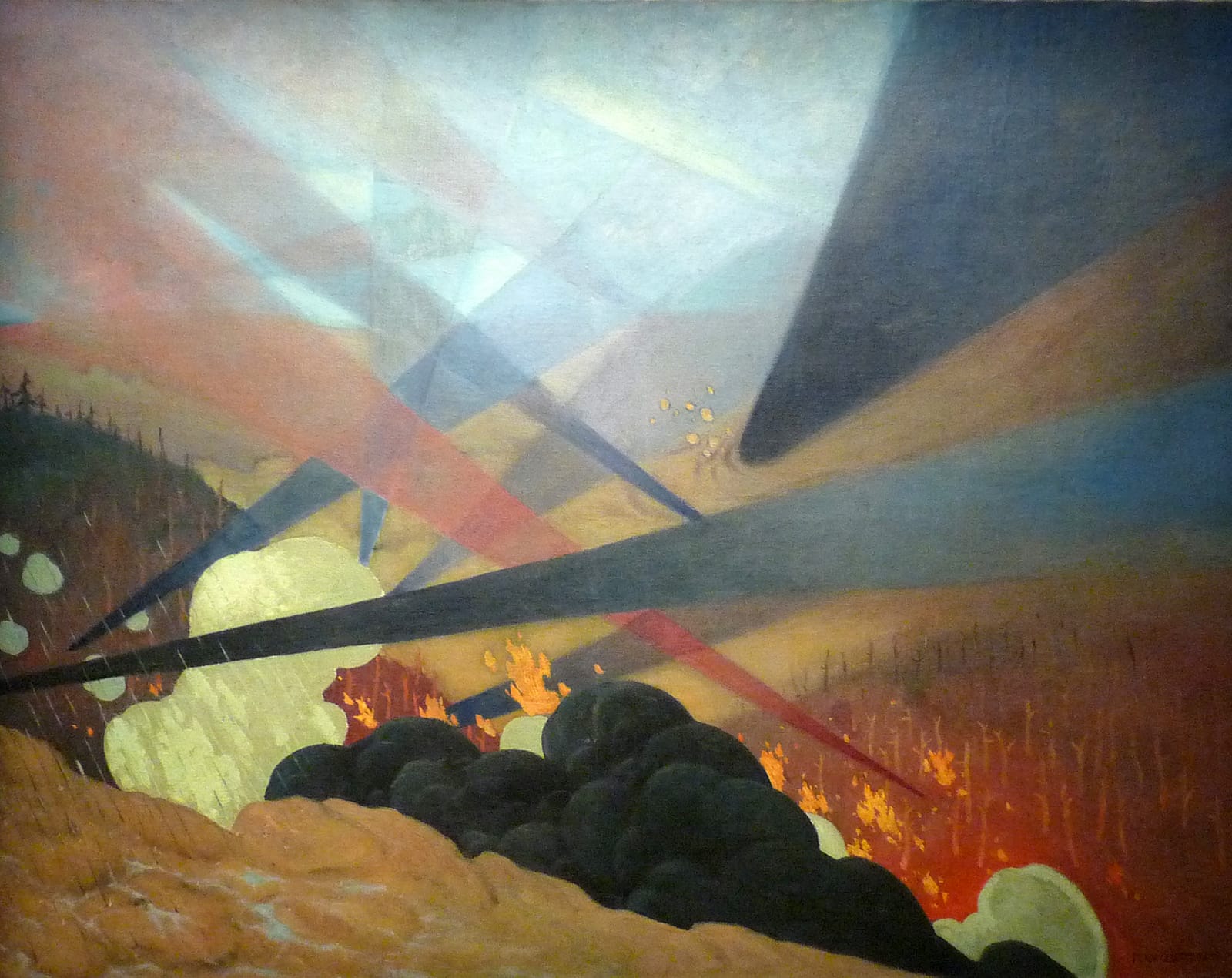
Verdun
Félix Vallotton · 1917 · Oil on canvas, 114 × 146 cm
Look for
- The beams of black, blue and red crossing above the fire to make triangles. Vallotton called them straight lines standing for forces, and insisted that did not mean cubism.
- The slanting lines of rain on the left, and the white and black gas clouds rolling over the ridge.
- Not one human figure. The burnt tree trunks on the right are the only vertical things left standing.
Transcript (2:00)
No one is in this picture. That is the first thing to register, standing in a room full of uniforms and helmets. Vallotton has painted the deadliest battle of the First World War, ten months of it in 1916, and left out every soldier.
What he gives you instead is geometry. Beams of black, blue and red slice across the canvas from the corners and cross above the fire to make triangles. On the left, slanted lines of rain fall on the ridge. In the middle, white and black clouds of gas roll over a ground that is nothing but shell holes and burning stumps. On the right a whole slope is on fire, and the burnt tree trunks are the only vertical things left standing.
Félix Vallotton was Swiss, naturalised French in 1900, a member of the Nabis alongside Bonnard and Vuillard, and famous for his woodcuts. When war came in August 1914 he was forty-eight. He volunteered and was turned down for his age. On the twenty-ninth of February 1916, in the first weeks of the battle, he wrote that Verdun, this place of death, must have something frightful and at the same time brilliant about it. He was later sent on a short mission near the front. He never went to Verdun.
That is worth holding onto in front of the painting, because it was judged very early on to be one of the strongest images of the battle, and it is entirely imagined. Vallotton said what he was trying to do. He called it an attempt at expression through straight lines, which, he insisted, did not mean cubism. He wanted to paint forces rather than reproduce the material effects of war, and he admitted that forces have no form and no colour, which is what made the job hard. The museum's own page says he took inspiration from Cubism anyway. The painter would have argued.
Look at the beams again. They are light and fire drawn as straight lines, the machinery of a battle the German artillery set out to fight as a way to bleed the French infantry white, and the human beings have been removed from the picture in favour of the machines. The signature is in the bottom right corner with the year, 1917; the museum's database dates it to December of that year. The museum bought it in 1976 from a Paris gallery, and today it is the picture the museum uses on its own plan as the emblem of these rooms.

Stop 3 of 5 · Louis XIV – Napoleon department, 17th – 19th century
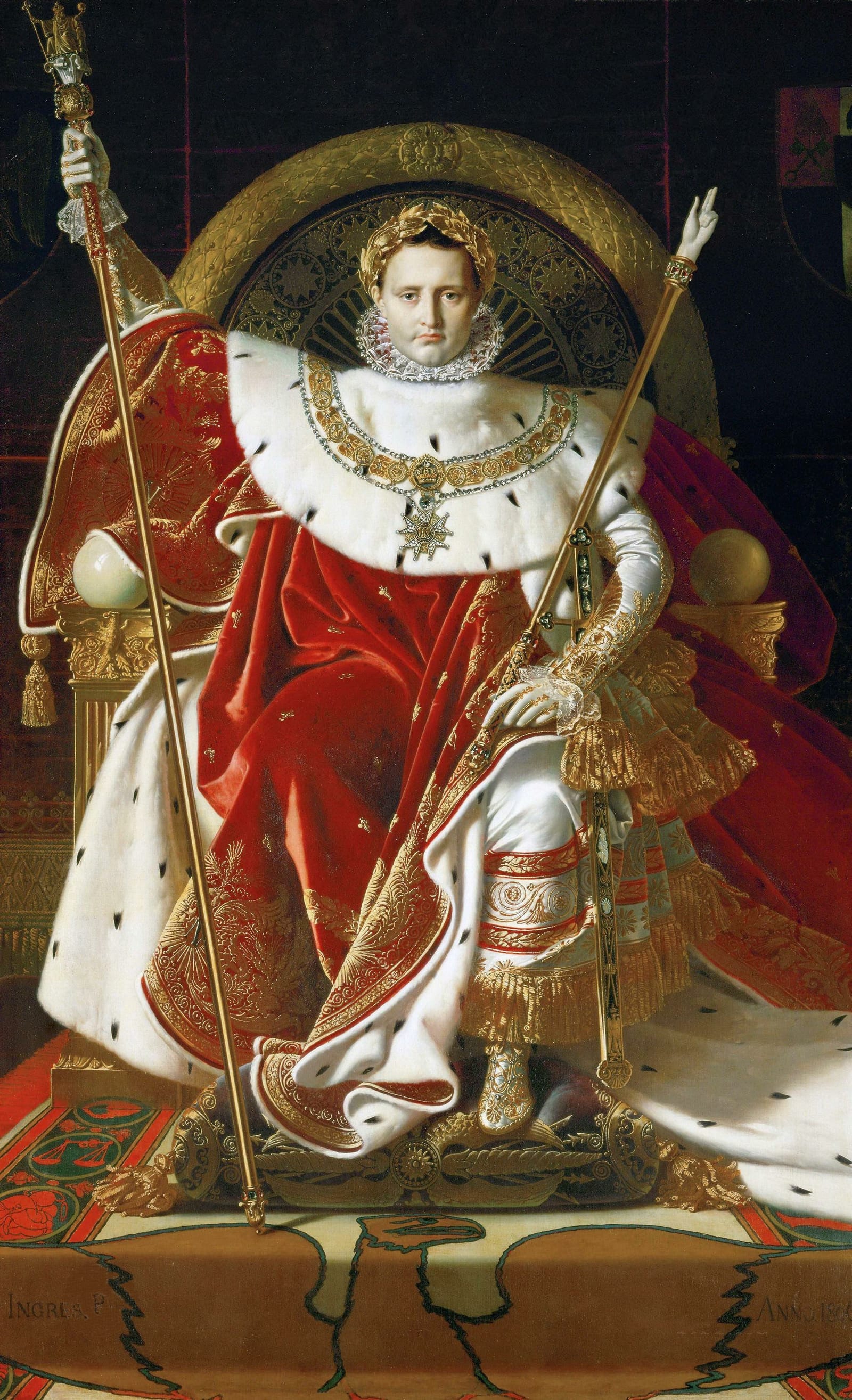
Napoleon I on his Imperial Throne
Jean-Auguste-Dominique Ingres · 1806 · Oil on canvas, 260 × 163 cm
Look for
- The shield cut off by the top right edge. It carries the arms of the kingdom of Italy, the clue that the painting was meant to go to Italy.
- The small Raphael Madonna hidden in the left border of the carpet, among the signs of the zodiac.
- The golden bees on the purple robe, and the statuette of Charlemagne on top of the sceptre in his right hand.
Transcript (2:08)
He is looking straight at you, and almost nothing else in the picture moves. Ingres has set the Emperor dead centre, face on, symmetrical, with a golden laurel wreath on his head and two long rods framing him like a pair of brackets. In his right hand is a sceptre topped with a tiny statuette of Charlemagne. In his left, the hand of Justice. At his side, a sword modelled on Joyeuse, Charlemagne's legendary blade. The purple velvet robe is sewn with golden bees, the Empire's chosen emblem alongside the eagle. This is the costume Napoleon wore for his coronation at Notre-Dame on the second of December 1804, and Ingres painted it two years later, aged twenty-six.
Everyone hated it. Shown at the Salon of 1806 as number 272, the painting was called Gothic and barbarous. The critics were unanimous, and Jacques-Louis David, then finishing his own enormous Coronation, judged it severely. What upset them is what makes it strange now: the frontal pose that turns a living man into an idol, the head emerging from a mass of fur and velvet like a face in a Byzantine icon, or Jupiter on his throne. The art historian Robert Rosenblum thought Ingres had borrowed the pose from Van Eyck's God the Father on the Ghent Altarpiece, which was hanging in the Louvre at the time.
Look at the top right corner. A shield is cut off by the edge of the canvas. It carries the arms of the kingdom of Italy, which is why the museum thinks the painting was meant to be sent to Italy, to show Napoleon as its king. The historian Sébastien Allard suggests the Italian commissioners refused it, and that is how it came to belong to the French legislature instead.
Now crouch a little and look at the carpet. Along its left border, among medallions of the zodiac, Ingres has slipped in a small version of Raphael's Madonna della seggiola. He worshipped Raphael and hid tributes to him in painting after painting. Here the tribute sits under the Emperor's feet.
The canvas is two metres sixty high. It belonged to the Legislative Assembly until 1814, passed to the royal museums, and in 1832 it was sent here to the Invalides, hung first in the chapel and from 1860 in the library. The Louvre still carries it on its inventory as number 5420. The portrait that Paris laughed at in 1806 is now, by the museum's own reckoning, one of the most famous images of Napoleon there is.
Agence de presse Meurisse. Agence photographique (commanditaire), Public domain, via Wikimedia Commons. Photo: Agence de presse Meurisse. Agence photographique (commanditaire)
_-_btv1b9018889k.jpg)
Stop 4 of 5 · Louis XIV – Napoleon department, 17th – 19th century, in the sealed case installed in 2016
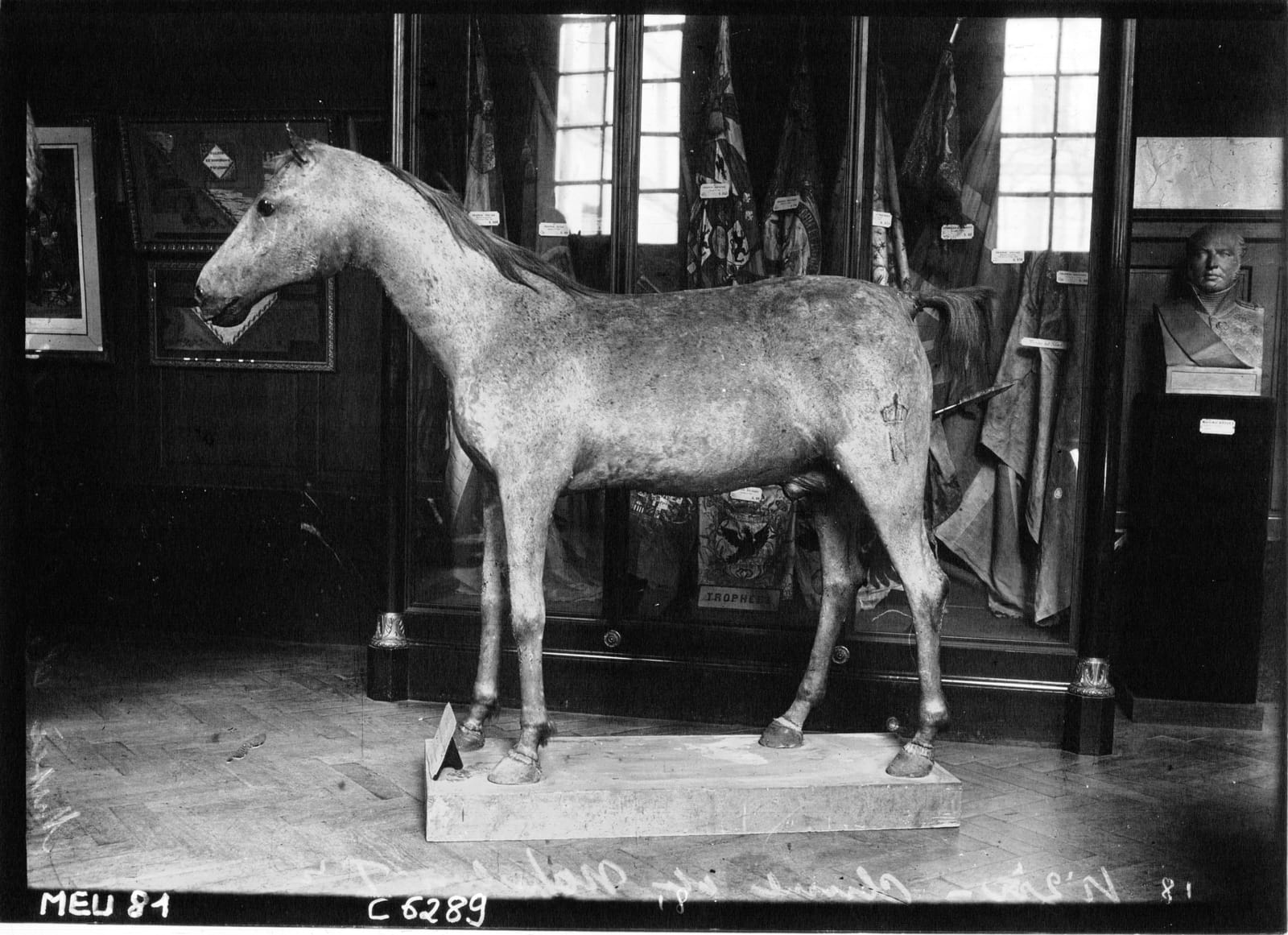
Vizir, Napoleon's horse
Arabian stallion, gift of Sultan Selim III; mounted by an unknown taxidermist in England · 1793–1826, mounted 1839 · Naturalised skin over wood, hemp and iron, 135 cm at the withers
Look for
- The brand on his left hind thigh: a crowned N, the mark of the Imperial Stables.
- How small he is. A metre thirty-five at the shoulder, pony height today, and this was a war horse at Jena and Eylau.
- The colour of the coat, restored in 2016 after decades of fading and repainting. It is the detail the specialists argue about.
Transcript (1:59)
He is smaller than you expect. One metre thirty-five at the shoulder, the height of a large pony, and this is what a war horse looked like in 1806. Vizir was an Arabian stallion, grey, a gift to Napoleon from Sultan Selim the Third of Turkey. The Emperor rode him from 1805, and he carried him at Jena in 1806 and at Eylau in 1807. Napoleon owned around a hundred and thirty horses in his lifetime. This is the only one known to survive as a mounted skin.
Walk round to his left hind leg. On the thigh is a brand, a crowned N, the mark of the Imperial Stables. It is the reason he is here at all. Vizir outlived his master by five years and died in 1826, in a France where a relic of Bonaparte was a dangerous thing to own. He was emptied, and his skin, with that seal on it, was hidden from royalist agents. In 1839 the skin was taken to England and mounted there. It came back to France in 1868, and then spent thirty years forgotten in an attic of the Louvre. In 1905, the year this museum was founded, he was brought here.
By 2016 he was in a bad way. Too much light and too dry an atmosphere had faded and cracked the skin, which had been repainted and patched in the nineteen-sixties; the museum counted forty-three cracks. Rather than quietly send him to the conservators, it asked the public. More than two hundred and seventy donors gave over twenty-six thousand euros, and two specialists in taxidermy, Yveline Huguet and Jack Thiney, spent more than a month on him: X-rays, filling the cracks, cleaning, rehydrating and recolouring the coat. Then he went into the sealed, climate-controlled case you are looking through.
The X-rays turned up a surprise. There is not a single bone inside him. What holds the shape is wood, hemp, nails, screws and iron rods, the work of that taxidermist in England in 1839.
And there is a doubt the museum itself has aired, in its own blog series about saving him. Some specialists say the colour of this coat does not match the Vizir that Horace Vernet painted, and that the horse in the case might be another of the Emperor's mounts. The brand says Imperial Stables. It does not say which horse.
Guilhem Vellut from Paris, France, CC BY 2.0, via Wikimedia Commons. Photo: Guilhem Vellut from Paris, France
.jpg)
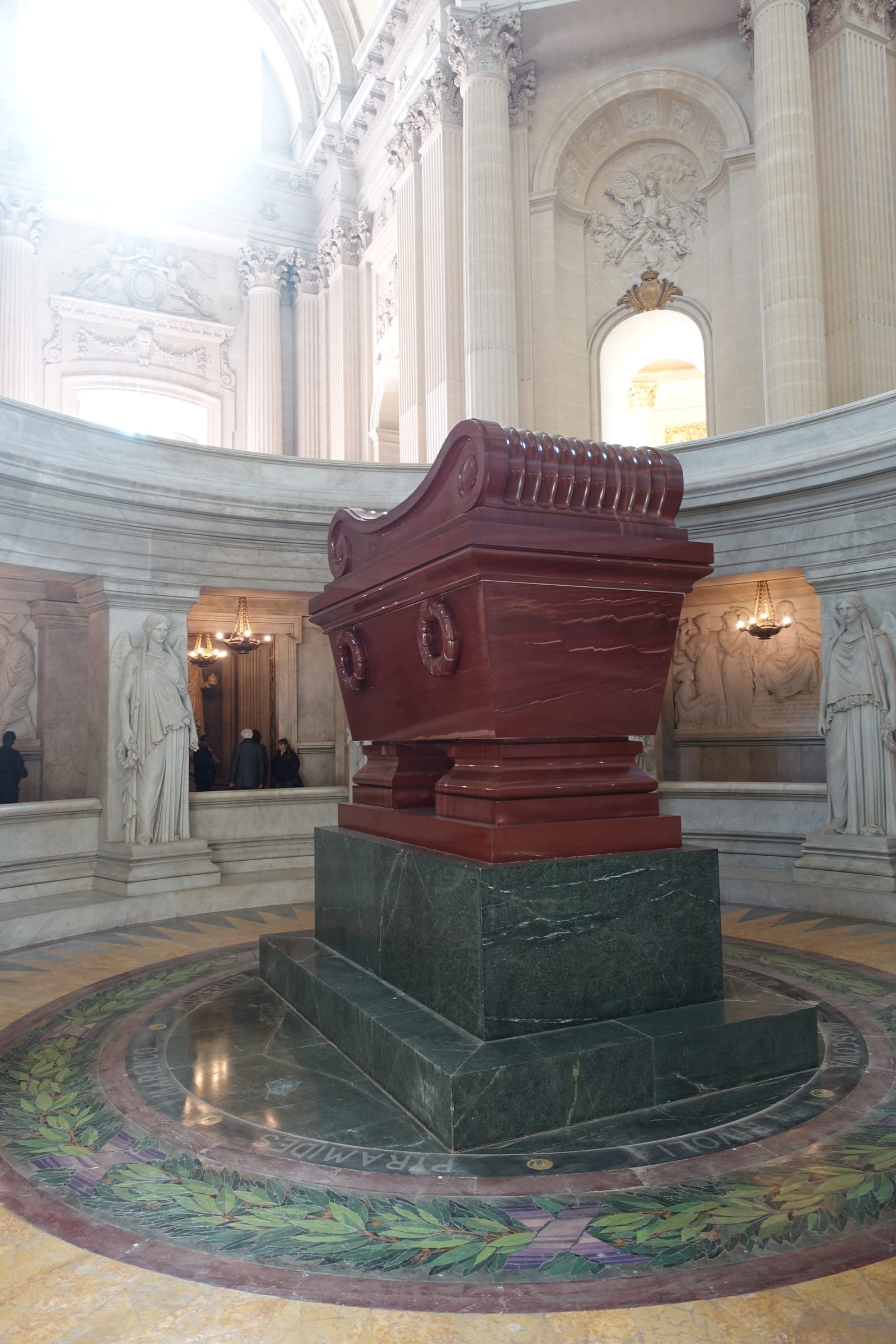
Stop 5 of 5 · Dôme des Invalides, open crypt beneath the dome
Tomb of Napoleon I
Louis Visconti, architect; sculpture by James Pradier, Pierre-Charles Simart and Francisque Duret · 1840–1861 · Red quartzite sarcophagus on a green granite base, in an open circular crypt
Look for
- The colour of the stone. It is red quartzite from Karelia, not the porphyry the old guidebooks named, on a base of green granite from the Vosges.
- The twelve pillars of the gallery that circles the crypt, with relief panels of the Emperor's achievements between them.
- The company he keeps: Foch and Lyautey, Vauban's mausoleum, his brothers Joseph and Jérôme, and his son, the Eaglet, all in the same building.
Transcript (2:18)
You are looking down at him. That is how the architect built it. Louis Visconti cut a circular crypt into the floor under the dome, open to the church above, so that anyone who comes to see Napoleon has to lean over the balustrade and bow their head to do it. Take the stairs down and the sarcophagus towers over you instead.
The stone is the first thing everyone asks about. It is not porphyry, whatever the older guidebooks say. It is red quartzite from a quarry in Karelia that belonged to Tsar Nicholas the First of Russia, standing on a base of green granite from the Vosges. Inside it are six coffins, one inside the next, and inside the sixth is the Emperor.
He should not be here at all. Napoleon died on Saint Helena in 1821 and was buried there. In 1840 King Louis-Philippe decided to bring him home, and on the fifteenth of December that year the coffin arrived under this dome and was placed in the Saint-Jérôme chapel to wait. It waited a long time. Visconti had to dig out the centre of a seventeenth-century church to make the crypt, and he died in December 1853 with the work unfinished. The body was finally laid in the sarcophagus on the second of April 1861, more than twenty years after it came back to Paris.
The building itself is older than any of this. Jules Hardouin-Mansart built it from 1677 as the royal chapel of the Invalides, the home for old soldiers that Louis the Fourteenth founded, and its gilded dome was the tallest thing in Paris until the Eiffel Tower. During the Revolution it became a temple of the god Mars. In 1800 Napoleon himself had the tomb of Turenne, Louis the Fourteenth's great general, moved here and declared the church a pantheon of military glory. Vauban followed a few years later. Napoleon was choosing the company he would keep.
Look around the gallery that circles the crypt. Twelve pillars, and between them relief panels celebrating what the Emperor did, with sculpture by Pradier, Simart and Duret. Then think about who else lies in the building: his brothers Joseph and Jérôme, his son Napoleon the Second, the Eaglet, his generals Bertrand and Duroc, and the marshals of a later war, Foch and Lyautey.
One story from the building's darkest years. In the Second World War the occupying army made the Invalides a barracks. The Morin family, who lived on the premises, hid Allied airmen here, under the noses of the garrison, for three years.
And the stone he was first buried under on Saint Helena came back with him in 1840. It stands a short walk from here in the cour de Nîmes, a garden along the Saint-Louis church: a plain gravestone from an island in the South Atlantic, a few hundred steps from all this red stone.
Independent guide · Chiaro
Point Chiaro at anything in the Musée de l'Armée.
Les Invalides holds close to half a million objects and this page carries five of them. Photograph a bronze cannon in the courtyard, a marshal's baton, a plan-relief of a fortress town, a helmet with a dent in it: Chiaro identifies the thing, explains why the army held on to it, and fields your questions until you move on.
Before you go
Getting there
Hôtel national des Invalides, 129 rue de Grenelle, 75007 Paris. Two entrances: 129 rue de Grenelle on the Esplanade side, which is also the accessible entrance and the only one open on first-Friday late nights, and 2 place Vauban on the Dôme side, the quickest way to the tomb.
Métro line 8 to La Tour-Maubourg or Invalides, line 13 to Varenne, or RER C to Invalides. Buses 28, 63, 69, 82, 83, 92 and 93 stop at Invalides or La Tour-Maubourg.
Tickets
- Open every day, 10am to 6pm, and closed only on 1 January, 1 May and 25 December. There is no weekly closing day. The tills shut half an hour before the museum.
- One 17-euro ticket covers the permanent collections, the church of the Dôme and the tomb. Under-18s go free, and under-26 residents of the European Economic Area get the permanent collections free, but everyone with free entry must still collect a ticket at the tills.
- The Royal Room of the arms and armour department is under renovation, and some armours are shown elsewhere in the museum or on loan. Ask at the desk where the Dauphin's armour stands today.
- On the first Friday of the month the museum stays open until 10pm on a 10-euro ticket, with the Dôme included; the only entrance that evening is 129 rue de Grenelle.
- Going to the Musée Rodin as well, in the immediate vicinity of Les Invalides? A combined ticket costs 26 euros and is valid for three months.
- On 19 and 20 September 2026, the European Heritage Days weekend, the museum is open 10am to 6pm and entry is free, so do not buy a ticket for those two days.
The official audio guide
The museum's own digital guide is being renovated and is not on offer at the moment, so there is nothing to rent at the desk. The museum sells guided tours through its partner Cultival, 19.50 euros full price and 8 euros for under-18s. What you are reading costs nothing: five stops, each with its full text beneath the player, while the Chiaro app handles the rest of the building from a photo.
Official site →Questions
Is there a free Musée de l'Armée audio guide?
This is one. Its five stops stream straight to your phone's browser and print their full script under the player, with no download involved. Anywhere else in Les Invalides, take a picture of the object and let the Chiaro app explain it.
How much is the official Musée de l'Armée audio guide?
There is none to rent at the moment. The museum says its digital tour guide is being renovated. Guided tours run by its partner Cultival cost 19.50 euros full price and 8 euros for under-18s, on top of admission.
Where is Napoleon's tomb in the Musée de l'Armée?
Under the Dôme des Invalides, the gilded dome at the south end of the complex, in an open crypt beneath the cupola with stairs down to the sarcophagus. The Dôme is on the same 17-euro ticket as the museum. The place Vauban entrance brings you straight to it.
Is the Musée de l'Armée closed on Mondays?
No. It is open every day from 10am to 6pm, including Mondays, and closes only on 1 January, 1 May and 25 December. On the first Friday of each month it stays open until 10pm.
How much does the Musée de l'Armée cost?
17 euros full price, 12 euros reduced, and 10 euros on first-Friday late openings. The ticket covers the permanent collections, the Dôme and Napoleon's tomb, the temporary exhibition, the Musée de l'Ordre de la Libération and the Musée des Plans-Reliefs. Under-18s are free; under-26 residents of the European Economic Area get the permanent collections free.
How long does the Musée de l'Armée take?
Allow roughly an hour and a quarter of walking for the five stops, stairs in the west wing and the walk round the courtyard to the Dôme included; the audio itself is about ten and a half minutes. A full visit of the three departments and the Dôme is a half day.
More audio guides
Made by Chiaro. Not affiliated with the Musée de l'Armée.